Current issue
Online first
Archive
About the Journal
Aims and scope
Editorial Board
International Editorial Board
List of Reviewers
Abstracting and indexing
Ethical standards and procedures
REMV in Social Media
Contact
Instructions for Authors
Instructions for Authors
Manuscript formatting template
Title page
Highlights
Payments
‘Ghostwriting’ and ‘Guestauthorship’
Guidelines for Referees



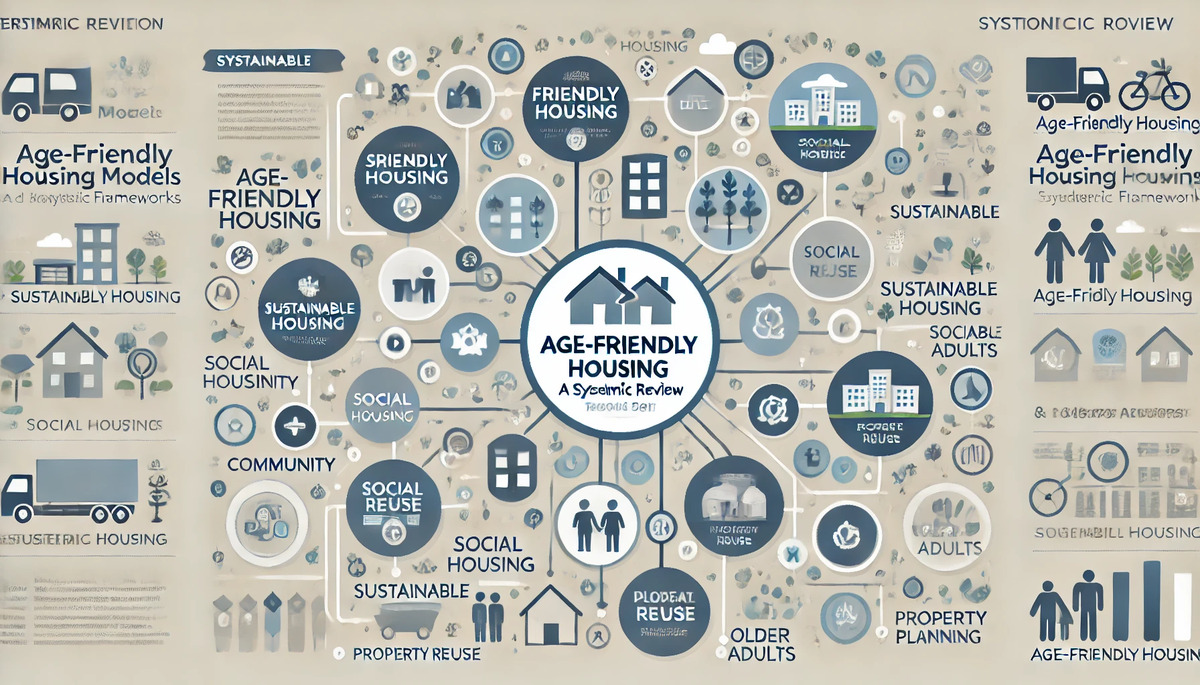
Age-friendly housing models and frameworks: A systematic review
1
Riga Technical University, Latvia
2
Kaunas University of Technology, Latvia
Submission date: 2024-11-12
Final revision date: 2026-02-26
Acceptance date: 2026-06-04
Publication date: 2026-06-13
REMV; 2026;34(2):45-59
HIGHLIGHTS
- evolution from single-domain to ecosystem approaches in age-friendly models
- smart technology emerges as key component in recent age-friendly frameworks
- five frameworks show shift toward environmental and sustainability considerations
- participatory planning proves effective through medellín's age-friendly development
KEYWORDS
TOPICS
- I31 - General Welfare, Well-Being
- J14 - Economics of the Elderly • Economics of the Handicapped • Non-Labor Market Discrimination
- O18 - Urban, Rural, Regional, and Transportation Analysis • Housing • Infrastructure
- R31 - Housing Supply and Markets
- R38 - Government Policy
- R52 - Land Use and Other Regulations
ABSTRACT
With the increase in the average age of the population worldwide, the demand for suitable housing solutions has also increased considerably. This systematic review focuses on the five most developed frameworks for age friendly housing which have been developed over the last two decades, how they have been shaped and how they are used in the context of property reuse and social housing development. Drawing on the WHO Age-Friendly Cities model, the Age-Friendly Ecosystem, the Smart Age-Friendly Ecosystem (SAfE), the Ageing Well Urban Planning Model, and the Concept of Age-Friendly Smart Ecologies (CASE), this study observes a shift from monocentric strategies to polycentric and ecosystem centrism models. The results demonstrate how, in the process of extending these frameworks, issues of technology, sustainability and community engagement remain at the core of creating age friendly places, along with the focus on environmental complexities. Meanwhile, this review analyzes the advantages and shortcomings of the frameworks and guidelines applicable to researchers, policymakers and practitioners dealing with urban planning and gerontology. The analysis addresses the question of how older adults can be accommodated through property reuse and social housing in a way that is sustainable and inclusive.
Share
RELATED ARTICLE
| eISSN: | 2300-5289 |

We process personal data collected when visiting the website. The function of obtaining information about users and their behavior is carried out by voluntarily entered information in forms and saving cookies in end devices. Data, including cookies, are used to provide services, improve the user experience and to analyze the traffic in accordance with the Privacy policy. Data are also collected and processed by Google Analytics tool (more).
You can change cookies settings in your browser. Restricted use of cookies in the browser configuration may affect some functionalities of the website.
You can change cookies settings in your browser. Restricted use of cookies in the browser configuration may affect some functionalities of the website.