Current issue
Online first
Archive
About the Journal
Aims and scope
Editorial Board
International Editorial Board
List of Reviewers
Abstracting and indexing
Ethical standards and procedures
REMV in Social Media
Contact
Instructions for Authors
Instructions for Authors
Manuscript formatting template
Title page
Highlights
Payments
‘Ghostwriting’ and ‘Guestauthorship’
Guidelines for Referees



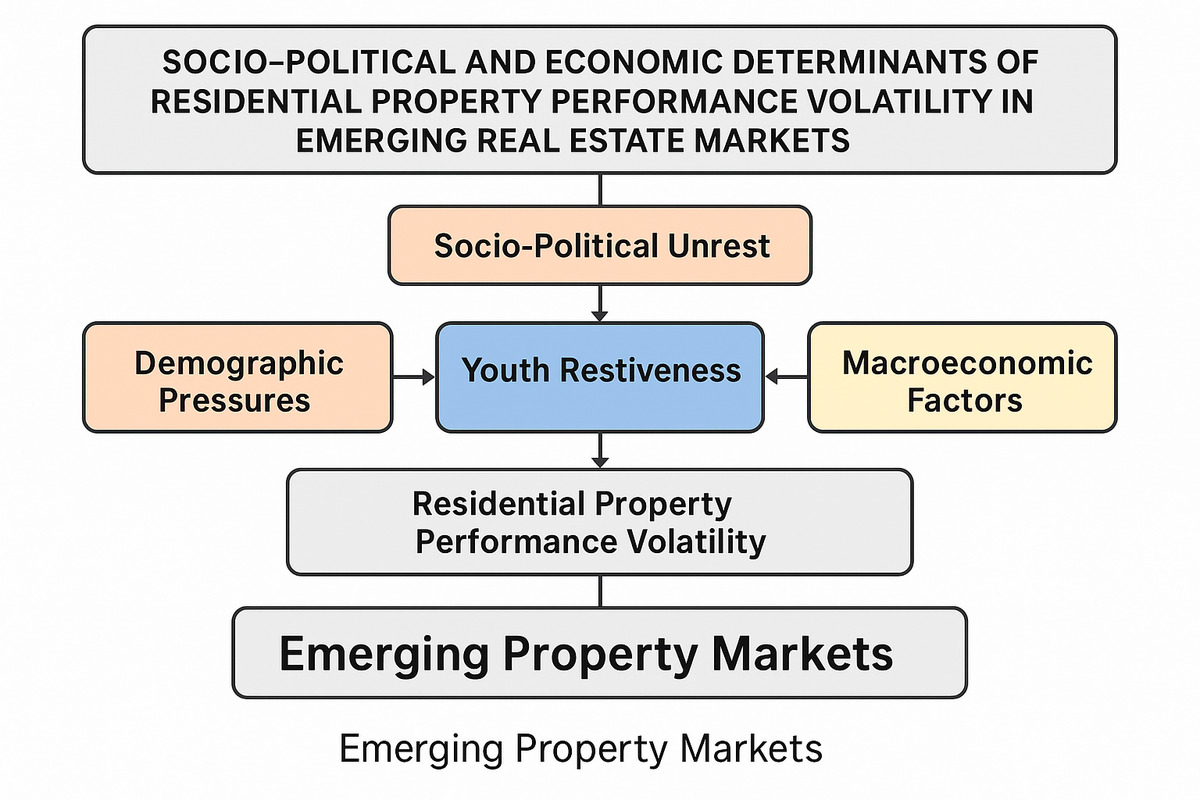
Socio-political and economic determinants of residential property performance volatility in emerging real estate markets
1
Department of Estate Management, Bayero University, Nigeria.
2
Department of Real Estate and Planning, Henley Business School, University of Reading, United Kingdom
Submission date: 2025-08-20
Final revision date: 2026-03-05
Acceptance date: 2026-04-12
Publication date: 2026-06-13
Corresponding author
Ibrahim Dabara Daniel
Department of Real Estate and Planning, Henley Business School, University of Reading, United Kingdom
Department of Real Estate and Planning, Henley Business School, University of Reading, United Kingdom
REMV; 2026;34(2):60-74
HIGHLIGHTS
- youth restiveness is the strongest driver of housing market volatility
- structural attributes explain 10.74% of housing market volatility
- The study reframes real estate risk with socio-political instability factors
KEYWORDS
TOPICS
ABSTRACT
This study investigates the determinants of residential property performance volatility in an emerging African real estate market, with particular emphasis on the interplay between socio-political unrest, demographic dynamics, and macroeconomic factors. Using a purposive sampling approach, data were obtained from 327 estate surveying and valuation firms across major Nigerian cities through structured questionnaires and expert interviews. Descriptive statistics and Principal Component Analysis (PCA) were employed to identify key drivers of volatility, following a three-stage analytical process involving factorability assessment, component analysis, and eigenvalue validation using Kaiser’s criterion. The findings reveal youth restiveness as the most dominant factor influencing residential property performance, followed by locational characteristics, structural attributes, population growth, and disposable income. Youth restiveness (driven by socio-political instability, unemployment, and economic uncertainty) was found to significantly undermine investor confidence and property values. The study contributes novel empirical insights into how socio-political volatility shapes real estate market behaviour in emerging economies. Beyond the Nigerian context, these findings have broader relevance for investors, practitioners, and policymakers, offering a framework for understanding and mitigating market instability while promoting resilient, inclusive, and sustainable real estate investment strategies in similar global markets.
| eISSN: | 2300-5289 |

We process personal data collected when visiting the website. The function of obtaining information about users and their behavior is carried out by voluntarily entered information in forms and saving cookies in end devices. Data, including cookies, are used to provide services, improve the user experience and to analyze the traffic in accordance with the Privacy policy. Data are also collected and processed by Google Analytics tool (more).
You can change cookies settings in your browser. Restricted use of cookies in the browser configuration may affect some functionalities of the website.
You can change cookies settings in your browser. Restricted use of cookies in the browser configuration may affect some functionalities of the website.