Current issue
Online first
Archive
About the Journal
Aims and scope
Editorial Board
International Editorial Board
List of Reviewers
Abstracting and indexing
Ethical standards and procedures
REMV in Social Media
Contact
Instructions for Authors
Instructions for Authors
Manuscript formatting template
Title page
Highlights
Payments
‘Ghostwriting’ and ‘Guestauthorship’
Guidelines for Referees



Supply-side risks in localized housing markets: Evidence from apartment development in China’s Third-Tier Cities

1
School of Finance and Economics, Qingdao Binhai University, China
2
Asia-Europe Institute, University of Malaya, 50603 Kuala Lumpur, Malaysia
3
Business School, University of New South Wales, Australia
4
Asia-Europe Institute, University of Malaya, Malaysia
5
School of Business Administration, Dankook University, Korea
These authors had equal contribution to this work
Submission date: 2026-08-17
Final revision date: 2026-10-21
Acceptance date: 2026-10-23
HIGHLIGHTS
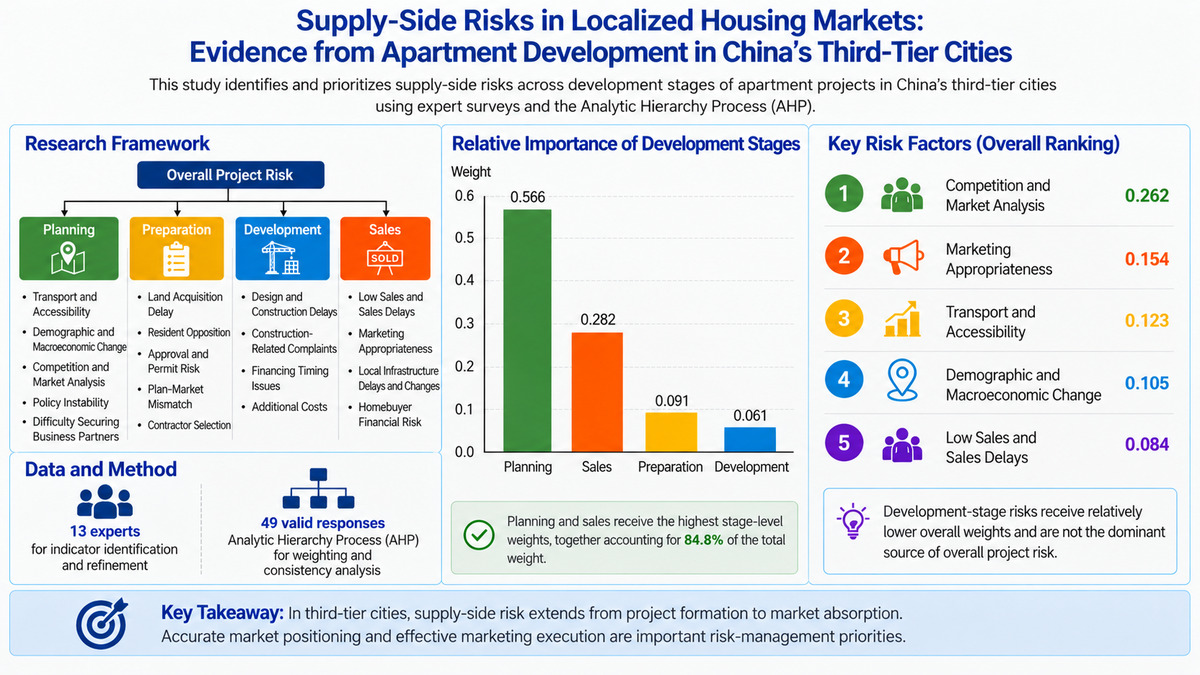
- planning and sales receive the highest risk weights in third-tier apartment projects
- competition and market analysis are the highest-ranked risk factors
- marketing appropriateness is the second-highest-ranked overall risk factor
- preparation and development risks are not dominant in the overall risk structure
- supply-side risk extends from project formation to the market realization of supply
KEYWORDS
apartment developmentThird-tier Citiesmarket competitionAnalytic Hierarchy Process (AHP)risk assessment
TOPICS
ABSTRACT
As China’s urbanization enters a more localized and intensive phase, the real estate sector is increasingly facing unique structural challenges in lower-tier markets, where capacity is limited, and sales pressure is high. This research investigates the risk landscape of market competition, marketing, and sales in apartment development projects within China’s third-tier cities to support strategic decision-making and project optimization. The study employs the Analytic Hierarchy Process (AHP) to analyze survey data from a panel of real estate experts, focusing on identifying critical risk factors across various development stages. The results show that the planning and sales stages receive relatively higher risk weights, indicating that early-stage market identification and subsequent sales performance are important components of the overall risk structure. Specifically, competition and market analysis and marketing appropriateness receive the highest composite weights, whereas broader macroeconomic factors do not dominate the overall risk structure. The findings suggest that accurate market positioning and effective marketing practices represent important risk-management priorities for apartment development projects in third-tier cities. These findings provide developers with an empirical basis for optimizing project positioning and sales strategies amid intense competition and limited market absorption.
| eISSN: | 2300-5289 |

We process personal data collected when visiting the website. The function of obtaining information about users and their behavior is carried out by voluntarily entered information in forms and saving cookies in end devices. Data, including cookies, are used to provide services, improve the user experience and to analyze the traffic in accordance with the Privacy policy. Data are also collected and processed by Google Analytics tool (more).
You can change cookies settings in your browser. Restricted use of cookies in the browser configuration may affect some functionalities of the website.
You can change cookies settings in your browser. Restricted use of cookies in the browser configuration may affect some functionalities of the website.