Current issue
Online first
Archive
About the Journal
Aims and scope
Editorial Board
International Editorial Board
List of Reviewers
Abstracting and indexing
Ethical standards and procedures
REMV in Social Media
Contact
Instructions for Authors
Instructions for Authors
Manuscript formatting template
Title page
Highlights
Payments
‘Ghostwriting’ and ‘Guestauthorship’
Guidelines for Referees



Editor's Choice
Do amenities enhance the value of office buildings? Dynamic causal impact of modern retrofitting
1
Commercial Property Research Institute, Inc.
2
Faculty of Engineering, Information and Systems, University of Tsukuba
3
Master’s Program in Policy and Planning Sciences, Graduate School of Science and Technology, University of Tsukuba
These authors had equal contribution to this work
Submission date: 2026-06-08
Final revision date: 2026-10-22
Acceptance date: 2026-10-29
HIGHLIGHTS
- Examining the causal effects of modern retrofits of office buildings
- Employing a staggered difference-in-differences event-study framework
- The installation of a shared lounge contributes to improved building performance
- Modern retrofits create vital functional value to combat obsolescence
KEYWORDS
TOPICS
ABSTRACT
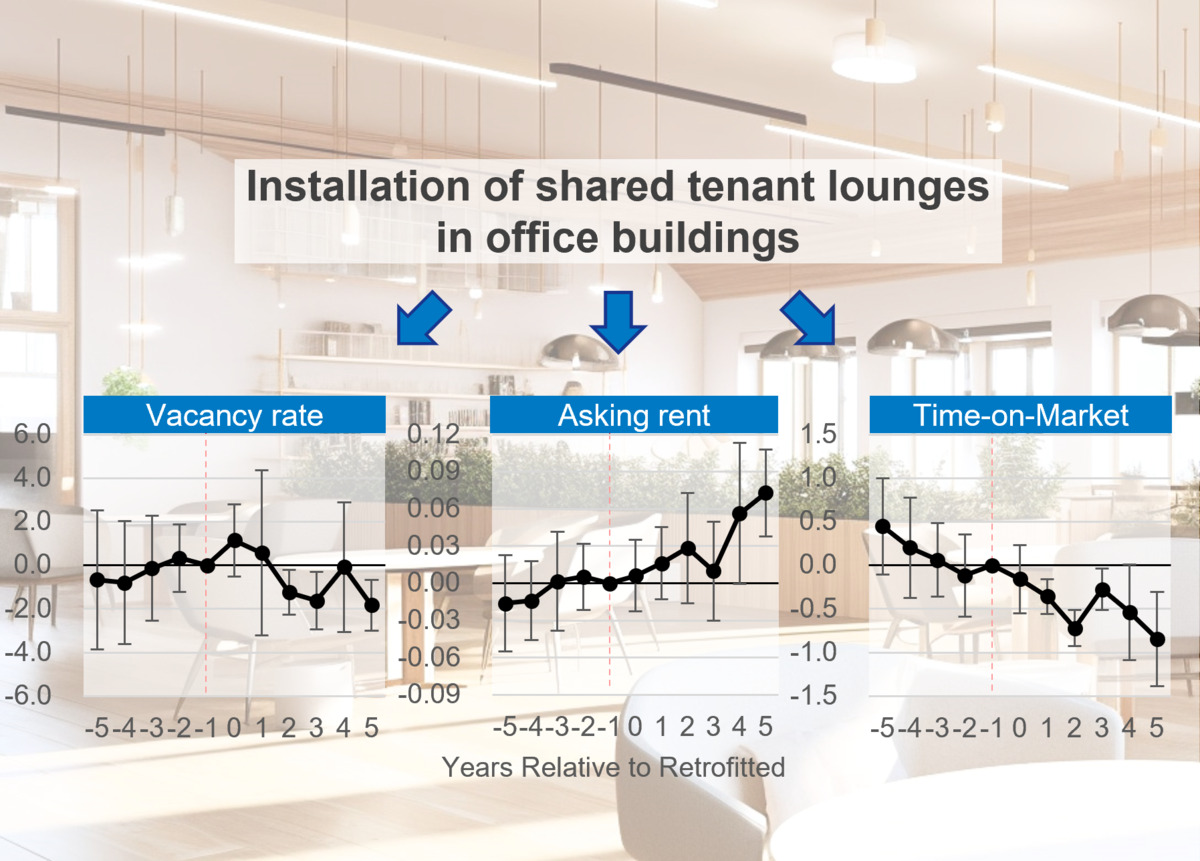
The post-pandemic shift to hybrid work has redefined tenant demand, turning offices from mere workspaces into collaborative, experiential hubs. Aging properties now face an obsolescence trilemma: retrofit, convert, or decline economically. Within the global "flight to quality" trend favoring modern, higher-standard space, this study quantifies the economic impact of building modernization. Using shared tenant lounge installation as a proxy for comprehensive modernization packages, we estimate its causal effect on commercial property performance. Focusing on large office buildings in Tokyo's five central wards, we apply a staggered difference-in-differences framework to a novel, manually constructed panel dataset. Results show that modernization shortens time-on-market by 24.2%–57.0% starting one year after installation, followed by a 1.2%–1.8% decline in vacancy rates from year two onward. Rent premiums then rise dynamically, reaching 7.56% by year five. Placebo-based robustness checks, though limited, substantiate these findings. We further identify a strategic stabilization mechanism: owners first prioritize filling vacancies to restore building vibrancy, then capture rent premiums as tenants' willingness to pay increases. These findings show that amenity-centric modernization creates functional value that mitigates obsolescence, though measured returns reflect an aggregate upgrade strategy rather than an isolated lounge effect, and apply specifically to high-grade assets in central business districts.
| eISSN: | 2300-5289 |

We process personal data collected when visiting the website. The function of obtaining information about users and their behavior is carried out by voluntarily entered information in forms and saving cookies in end devices. Data, including cookies, are used to provide services, improve the user experience and to analyze the traffic in accordance with the Privacy policy. Data are also collected and processed by Google Analytics tool (more).
You can change cookies settings in your browser. Restricted use of cookies in the browser configuration may affect some functionalities of the website.
You can change cookies settings in your browser. Restricted use of cookies in the browser configuration may affect some functionalities of the website.