Current issue
Online first
Archive
About the Journal
Aims and scope
Editorial Board
International Editorial Board
List of Reviewers
Abstracting and indexing
Ethical standards and procedures
REMV in Social Media
Contact
Instructions for Authors
Instructions for Authors
Manuscript formatting template
Title page
Highlights
Payments
‘Ghostwriting’ and ‘Guestauthorship’
Guidelines for Referees



Exchange rate volatility and house prices in the Eastern European countries

1
Cracow University of Technology, Poland
Submission date: 2026-04-06
Final revision date: 2026-07-27
Acceptance date: 2026-08-20
HIGHLIGHTS
- exchange rate volatility effects on house prices are quite heterogeneous
- exchange rate depreciation has a dampening effect on house prices
- controls for interest rate, income abroad, RER misalignment in the house price model
- our results support arguments against the exchange rate disconnect
- the quarterly exchange rate volatility is specified with the EGARCH(p,q) model
KEYWORDS
TOPICS
ABSTRACT
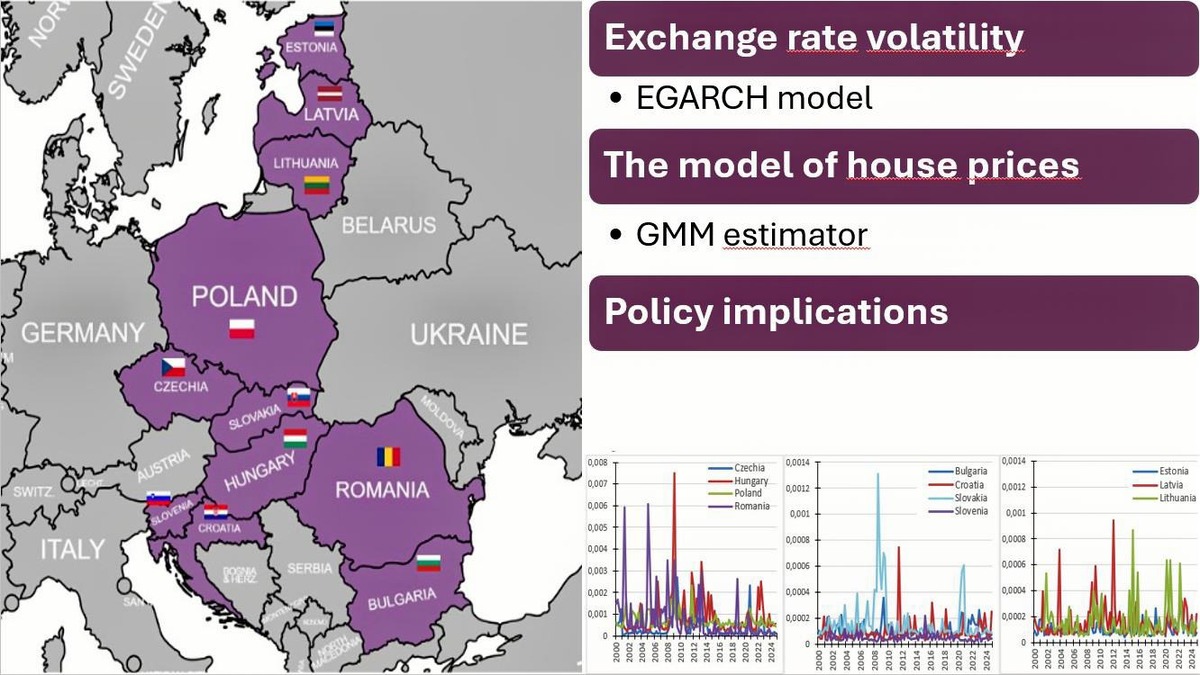
We analyzed the causal relationship between exchange rate volatility and house prices in 11 Eastern European countries. Exchange rate volatility was modelled using a GARCH framework, while the determinants of house prices were estimated with the GMM method. Based on quarterly data covering the period from 2004 to 2024, we established that exchange rate volatility effects on house prices are quite heterogeneous, with a statistically significant positive effect in 7 countries and a negative effect in 4 countries. However, there is a predominantly dampening effect of exchange rate depreciation on house prices, except Slovenia and Latvia. Among other findings, house prices exhibit inertia, which could be interpreted as the presence of speculative motives among market participants. An inverse relationship between interest rate and house prices is a distinct feature of countries with a floating exchange rate regime. Higher output abroad exerts an upward pressure on house prices in 5 countries, with the opposite effect in 3 countries. The real exchange rate misalignment is significant for house prices in eight countries. Joining the eurozone is likely to increase house prices. Main findings remain robust under different specifications of explanatory variables and the exchange rate volatility determinant.
| eISSN: | 2300-5289 |

We process personal data collected when visiting the website. The function of obtaining information about users and their behavior is carried out by voluntarily entered information in forms and saving cookies in end devices. Data, including cookies, are used to provide services, improve the user experience and to analyze the traffic in accordance with the Privacy policy. Data are also collected and processed by Google Analytics tool (more).
You can change cookies settings in your browser. Restricted use of cookies in the browser configuration may affect some functionalities of the website.
You can change cookies settings in your browser. Restricted use of cookies in the browser configuration may affect some functionalities of the website.