Current issue
Online first
Archive
About the Journal
Aims and scope
Editorial Board
International Editorial Board
List of Reviewers
Abstracting and indexing
Ethical standards and procedures
REMV in Social Media
Contact
Instructions for Authors
Instructions for Authors
Manuscript formatting template
Title page
Highlights
Payments
‘Ghostwriting’ and ‘Guestauthorship’
Guidelines for Referees


Municipal approaches to immovable property taxation in the Czech Republic
1
Department of Finance and Accounting, School of Business Administration in Karvina, Silesian University in Opava, Czech Republic
2
Department of Business Economics and Management, School of Business Administration in Karvina, Silesian University in Opava, Czech Republic
These authors had equal contribution to this work
Submission date: 2026-03-10
Final revision date: 2026-06-08
Acceptance date: 2026-07-21
Corresponding author
Šárka Sobotovičová
Department of Finance and Accounting, School of Business Administration in Karvina, Silesian University in Opava, Czech Republic
Department of Finance and Accounting, School of Business Administration in Karvina, Silesian University in Opava, Czech Republic
HIGHLIGHTS
- using of coefficients by municipalities is researched via a questionnaire survey
- the local coefficient has the most significant impact on the amount of tax revenue
- the differences in approaches between small and large cities were investigated
- most cities view their competencies to set the tax coefficients as adequate
KEYWORDS
TOPICS
ABSTRACT
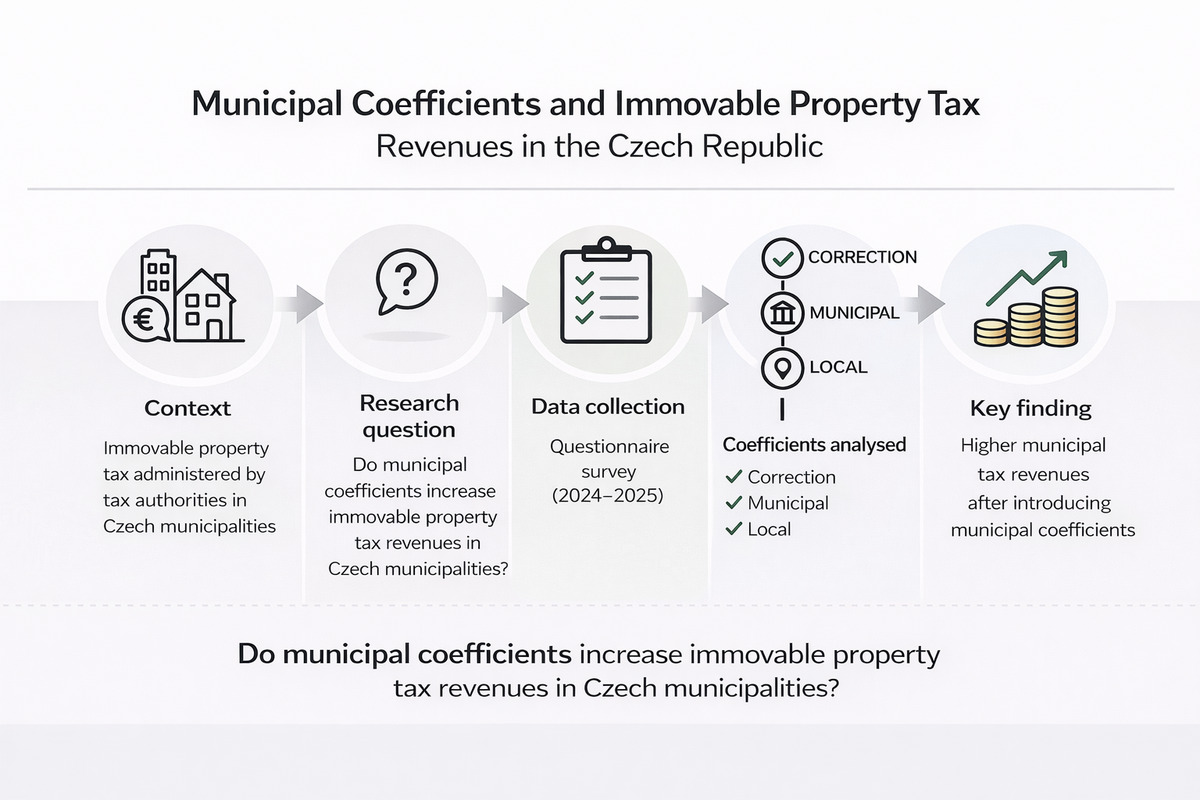
In the Czech Republic, as in most EU countries, property tax constitutes a traditional and stable source of municipal revenue. The administration and collection of immovable property tax in the Czech Republic is the responsibility of the tax authorities, while municipalities can influence the amount of revenue generated mainly through coefficients established by generally binding decrees. The primary aim of this research is to investigate how municipalities increase immovable property tax revenues through the use of coefficients, including correction, municipal, and local coefficients. This research is based on primary data gathered in 2024 and 2025 via a questionnaire survey conducted through personal interviews, emails, and phone calls. Recent legislative changes have extended the competence of municipalities to implement local coefficients. The findings of the study show that, although most municipalities across various size categories consider these options sufficient, the complexities of the legislative framework may pose challenges to the effective application of the local coefficient. Some municipalities offer financial benefits to residents in connection with the introduction of the local coefficient, often in the form of reductions or complete waivers of abolished municipal waste fees.
ACKNOWLEDGEMENTS
This paper was supported by the Ministry of Education, Youth and Sports in the Czech Republic within the Institutional Support for Long-term Development of a Research Organization in 2024.
| eISSN: | 2300-5289 |

We process personal data collected when visiting the website. The function of obtaining information about users and their behavior is carried out by voluntarily entered information in forms and saving cookies in end devices. Data, including cookies, are used to provide services, improve the user experience and to analyze the traffic in accordance with the Privacy policy. Data are also collected and processed by Google Analytics tool (more).
You can change cookies settings in your browser. Restricted use of cookies in the browser configuration may affect some functionalities of the website.
You can change cookies settings in your browser. Restricted use of cookies in the browser configuration may affect some functionalities of the website.