Current issue
Online first
Archive
About the Journal
Aims and scope
Editorial Board
International Editorial Board
List of Reviewers
Abstracting and indexing
Ethical standards and procedures
REMV in Social Media
Contact
Instructions for Authors
Instructions for Authors
Manuscript formatting template
Title page
Highlights
Payments
‘Ghostwriting’ and ‘Guestauthorship’
Guidelines for Referees



The impact of disaggregated physical climate risk on the volatility of property indices: Evidence from South Africa
1
University of KwaZulu-Natal, College of Law and Management Studies, Westville Campus, Durban, South Africa
These authors had equal contribution to this work
Submission date: 2026-03-13
Final revision date: 2026-06-11
Acceptance date: 2026-10-09
Corresponding author
Hilary Tinotenda Muguto
University of KwaZulu-Natal, College of Law and Management Studies, Westville Campus, Durban, South Africa
University of KwaZulu-Natal, College of Law and Management Studies, Westville Campus, Durban, South Africa
HIGHLIGHTS
- examines whether physical climate risks influence property market volatility
- drought, temperature and precipitation shocks drive volatility heterogeneously
- climate risks affect property markets mainly through uncertainty rather than prices
- garch–midas reveals slow transmission of climate shocks into property volatility
KEYWORDS
Physical climate riskProperty market volatilityGARCH-MIDAS frameworkSouth African marketListed property markets
TOPICS
ABSTRACT
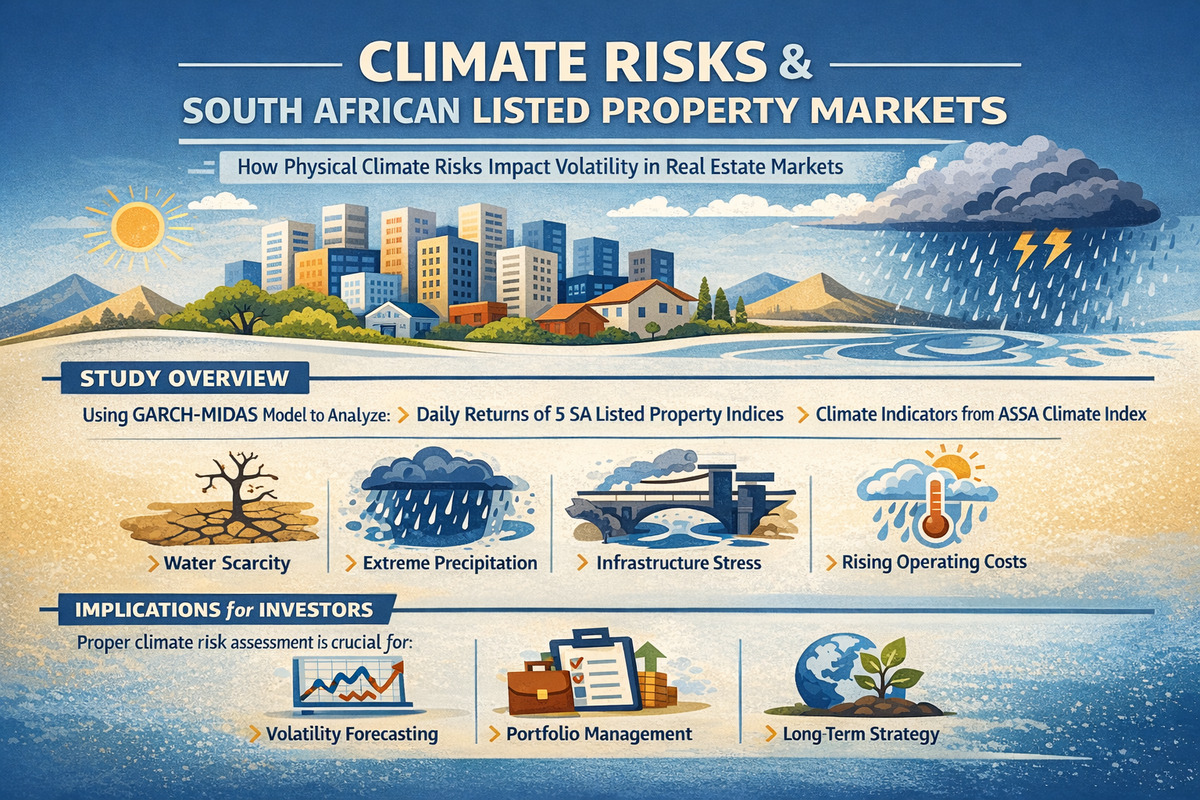
Climate change increasingly affects real estate markets because property assets are location-specific and directly exposed to environmental conditions. This study examines whether physical climate risks influence volatility in South African listed property markets. Using a GARCH–MIDAS framework, daily returns from five property indices are linked to monthly indicators of drought, extreme precipitation, and temperature extremes derived from the Actuarial Society of South Africa Climate Index. Results show that physical climate conditions contribute to persistent market volatility. Short-run volatility persistence is strong across all indices. Drought consistently increases long-run volatility, particularly in segmented indices, while broader indices show weaker effects. Temperature extremes exert the greatest influence, with minimum temperatures affecting most indices. Precipitation effects vary with flood exposure and infrastructure resilience, reducing volatility where rainfall alleviates drought stress and increasing it where flood risk dominates. These findings highlight the importance of incorporating physical climate risks into portfolio risk assessment, volatility forecasting, and long-term investment decisions in climate-exposed real estate markets.
| eISSN: | 2300-5289 |

We process personal data collected when visiting the website. The function of obtaining information about users and their behavior is carried out by voluntarily entered information in forms and saving cookies in end devices. Data, including cookies, are used to provide services, improve the user experience and to analyze the traffic in accordance with the Privacy policy. Data are also collected and processed by Google Analytics tool (more).
You can change cookies settings in your browser. Restricted use of cookies in the browser configuration may affect some functionalities of the website.
You can change cookies settings in your browser. Restricted use of cookies in the browser configuration may affect some functionalities of the website.