Current issue
Online first
Archive
About the Journal
Aims and scope
Editorial Board
International Editorial Board
List of Reviewers
Abstracting and indexing
Ethical standards and procedures
REMV in Social Media
Contact
Instructions for Authors
Instructions for Authors
Manuscript formatting template
Title page
Highlights
Payments
‘Ghostwriting’ and ‘Guestauthorship’
Guidelines for Referees



Evaluating online real estate education quality during and after COVID-19
1
Krakow University of Economics, Poland
Submission date: 2025-10-14
Final revision date: 2026-03-09
Acceptance date: 2026-05-04
Publication date: 2026-06-13
REMV; 2026;34(2):126-133
HIGHLIGHTS
- longitudinal study on online real estate education quality
- covid-19 changed student perception and learning preferences
- synchronous teaching improved learning outcomes
- practical recommendations for post-pandemic education
KEYWORDS
TOPICS
ABSTRACT
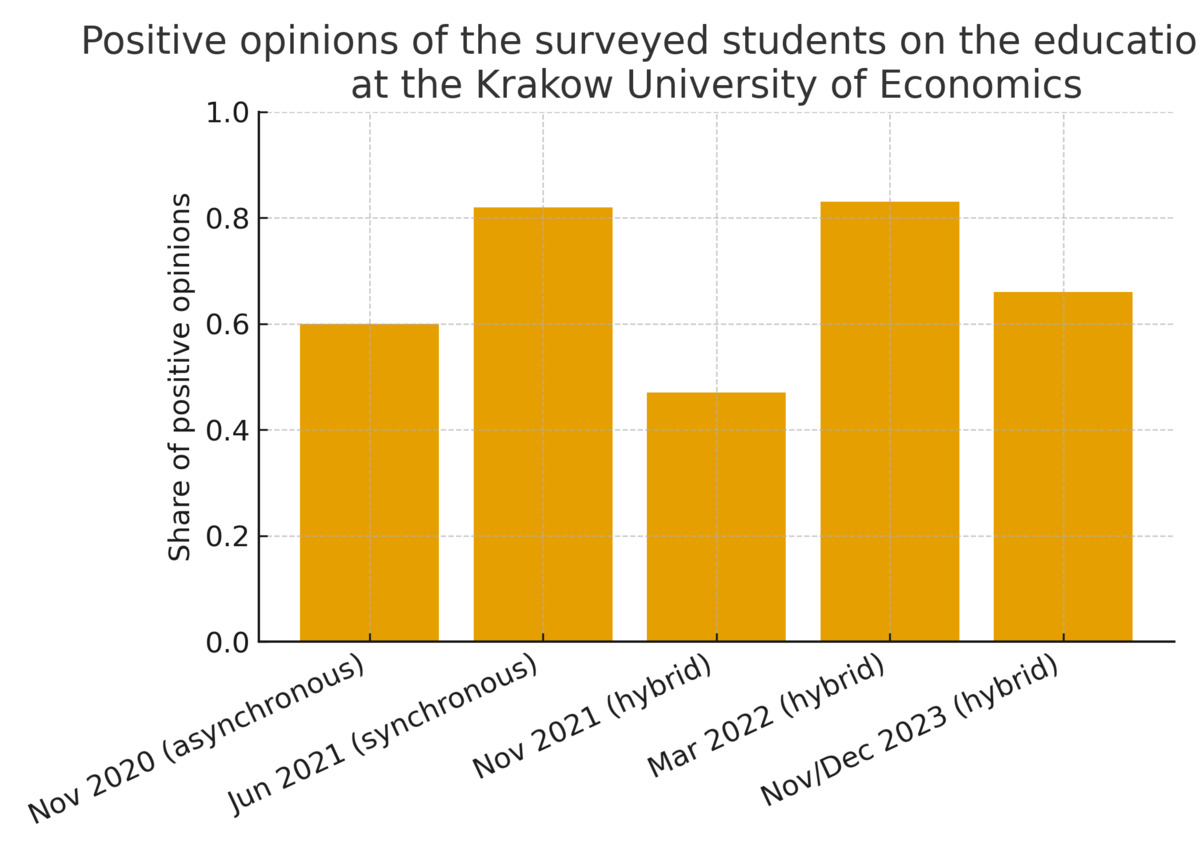
This paper investigates how students enrolled in real estate programs at the Krakow University of Economics (KUE) responded to various models of online and hybrid learning implemented during and after the COVID-19 pandemic. Drawing on five rounds of survey-based research conducted between 2020 and 2023, the study traces the evolution of student attitudes over time, particularly as instructional methods and faculty preparedness developed. While the research focuses on a single Polish institution, many of the observed trends align with patterns documented in other countries. The findings yield several actionable recommendations for enhancing online instruction in real estate education, including the use of synchronous formats where feasible, the integration of diverse pedagogical strategies, and the promotion of student well-being through meaningful interaction. Simultaneously, the study underscores the limitations of poorly coordinated hybrid models. In light of recent warnings from the Global Preparedness Monitoring Board (GPMB, 2024) regarding the high probability of future global health crises, the experiences discussed here may inform the development of more flexible and resilient teaching approaches within real estate education under conditions of uncertainty.
FUNDING
The publication presents the result of the Project no PRW/WPOT/2024/0038 financed from the subsidy granted to the Krakow University of Economics.
Share
RELATED ARTICLE
| eISSN: | 2300-5289 |

We process personal data collected when visiting the website. The function of obtaining information about users and their behavior is carried out by voluntarily entered information in forms and saving cookies in end devices. Data, including cookies, are used to provide services, improve the user experience and to analyze the traffic in accordance with the Privacy policy. Data are also collected and processed by Google Analytics tool (more).
You can change cookies settings in your browser. Restricted use of cookies in the browser configuration may affect some functionalities of the website.
You can change cookies settings in your browser. Restricted use of cookies in the browser configuration may affect some functionalities of the website.