Current issue
Online first
Archive
About the Journal
Aims and scope
Editorial Board
International Editorial Board
List of Reviewers
Abstracting and indexing
Ethical standards and procedures
REMV in Social Media
Contact
Instructions for Authors
Instructions for Authors
Manuscript formatting template
Title page
Highlights
Payments
‘Ghostwriting’ and ‘Guestauthorship’
Guidelines for Referees



HRM models in public and private social housing management organizations: A comparative study of Polish municipalities
1
University of Warmia and Mazury in Olsztyn, Poland
2
Sylwia Stachowska HR Consulting, Morenowa 9/32, 10-687 Bartąg, Poland
Submission date: 2026-02-14
Final revision date: 2026-06-12
Acceptance date: 2026-07-21
Publication date: 2026-09-08
REMV; 2026;34(3):131-146
HIGHLIGHTS
- HRM remains an important segment of social housing management
- social housing organizations strive to improve HRM efficiency
- HRM emphasizes other aspects in public and private organizations
- HRM efficiency requires different improvements in both types of organizations
KEYWORDS
TOPICS
ABSTRACT
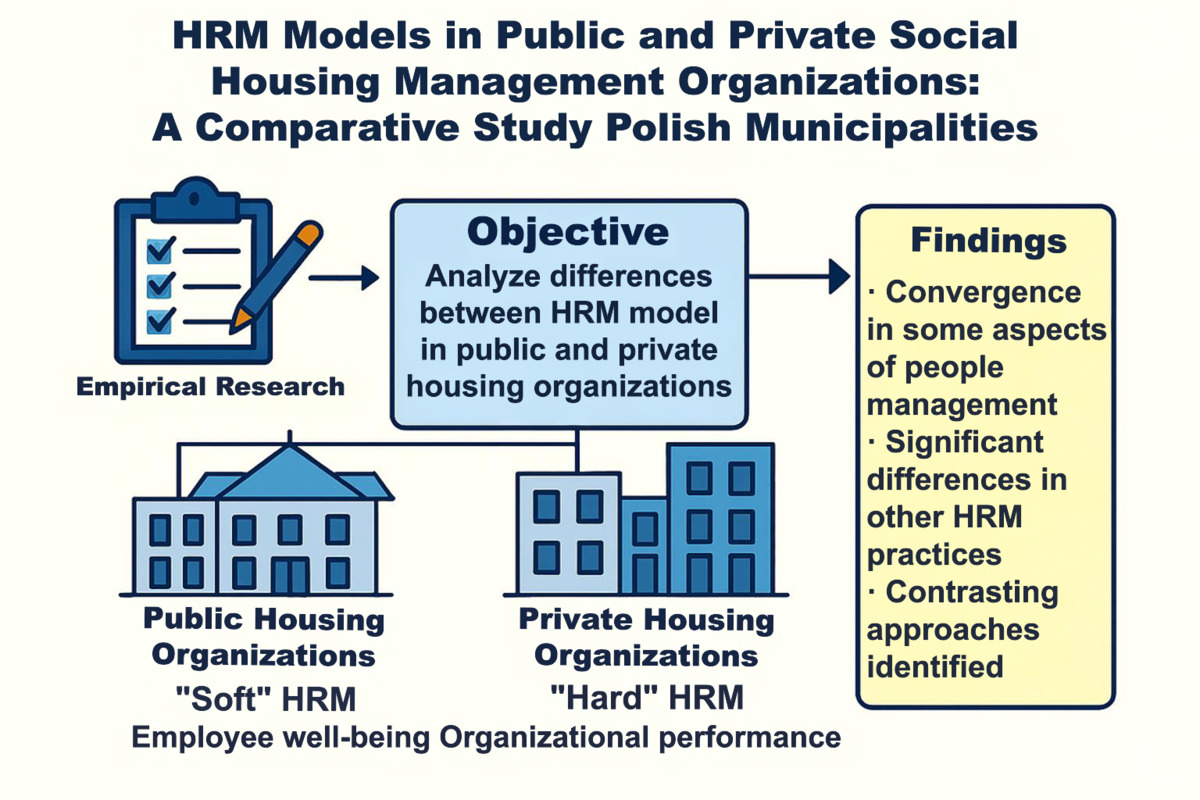
The study aimed to conduct a comparative analysis of human resource management (HRM) models in public and private housing organizations (HOs) managing municipal housing
in Poland and to identify differences between these models based on selected HRM characteristics. Empirical research was conducted using a multi-stage survey approach supported by statistical tests. The analysis was based on sub-samples of public and private HOs representing the population of urban municipalities in Poland. The results suggest that in some aspects of people management (e.g., recruiting employees, long-term employment, selection procedures), there was convergence between HRM models in public and private HOs, while in other aspects (e.g., performance assessment, hiring and remuneration rules, employee participation, motivation and evaluation, training and development, interpersonal relations), these models differed significantly, often showing opposite relations. The findings confirmed that public HOs adopted a “soft” HRM model focused on improving employee well-being, while private HOs used a “hard” model aimed at improving organizational performance. This article is the second study dedicated to HRM in the social housing management sector in Poland. The findings may also be of interest in other countries where social housing management is undergoing market transformations.
Share
RELATED ARTICLE
| eISSN: | 2300-5289 |

We process personal data collected when visiting the website. The function of obtaining information about users and their behavior is carried out by voluntarily entered information in forms and saving cookies in end devices. Data, including cookies, are used to provide services, improve the user experience and to analyze the traffic in accordance with the Privacy policy. Data are also collected and processed by Google Analytics tool (more).
You can change cookies settings in your browser. Restricted use of cookies in the browser configuration may affect some functionalities of the website.
You can change cookies settings in your browser. Restricted use of cookies in the browser configuration may affect some functionalities of the website.