Current issue
Online first
Archive
About the Journal
Aims and scope
Editorial Board
International Editorial Board
List of Reviewers
Abstracting and indexing
Ethical standards and procedures
REMV in Social Media
Contact
Instructions for Authors
Instructions for Authors
Manuscript formatting template
Title page
Highlights
Payments
‘Ghostwriting’ and ‘Guestauthorship’
Guidelines for Referees



Greener homes, reluctant buyers? Psychological and policy determinants of green housing intention among generation Z in an emerging economy
1
State University of Jakarta, Indonesia
These authors had equal contribution to this work
Submission date: 2026-04-08
Final revision date: 2026-08-10
Acceptance date: 2026-08-28
HIGHLIGHTS
- social norms
- personal value
- green housing
KEYWORDS
TOPICS
ABSTRACT
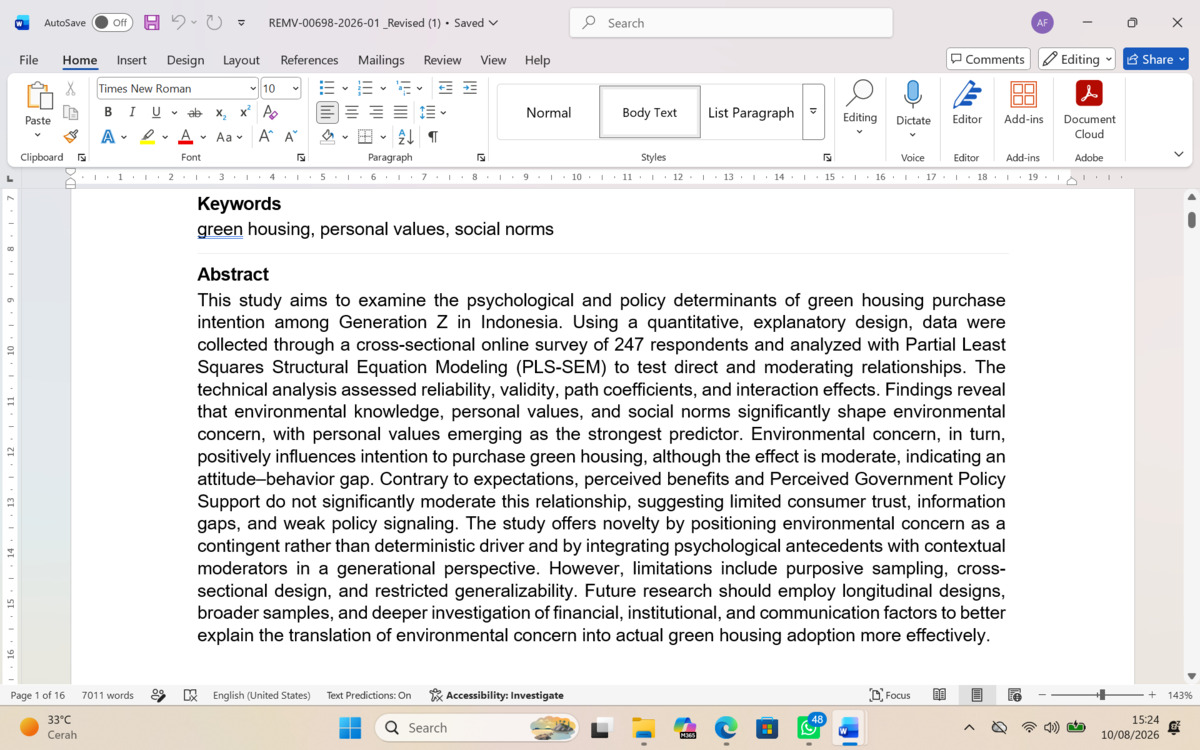
This study aims to examine the psychological and policy determinants of green housing purchase intention among Generation Z in Indonesia. Using a quantitative, explanatory design, data were collected through a cross-sectional online survey of 247 respondents and analyzed with Partial Least Squares Structural Equation Modeling (PLS-SEM) to test direct and moderating relationships. The technical analysis assessed reliability, validity, path coefficients, and interaction effects. Findings reveal that environmental knowledge, personal values, and social norms significantly shape environmental concern, with personal values emerging as the strongest predictor. Environmental concern, in turn, positively influences intention to purchase green housing, although the effect is moderate, indicating an attitude–behavior gap. Contrary to expectations, perceived benefits and Perceived Government Policy Support do not significantly moderate this relationship, suggesting limited consumer trust, information gaps, and weak policy signaling. The study offers novelty by positioning environmental concern as a contingent rather than deterministic driver and by integrating psychological antecedents with contextual moderators in a generational perspective. However, limitations include purposive sampling, cross-sectional design, and restricted generalizability. Future research should employ longitudinal designs, broader samples, and deeper investigation of financial, institutional, and communication factors to better explain the translation of environmental concern into actual green housing adoption more effectively.
ADDITIONAL INFORMATION
This research protocol was designed and executed in accordance with established ethical benchmarks for tracking human interactions in social sciences. The study design and questionnaire instrument were reviewed and formally approved by State University of Jakarta Ethics Committee.
| eISSN: | 2300-5289 |

We process personal data collected when visiting the website. The function of obtaining information about users and their behavior is carried out by voluntarily entered information in forms and saving cookies in end devices. Data, including cookies, are used to provide services, improve the user experience and to analyze the traffic in accordance with the Privacy policy. Data are also collected and processed by Google Analytics tool (more).
You can change cookies settings in your browser. Restricted use of cookies in the browser configuration may affect some functionalities of the website.
You can change cookies settings in your browser. Restricted use of cookies in the browser configuration may affect some functionalities of the website.